Triangular nozzle
- strip parquet to EN 13226
- multi-layer parquet at least 90 cm long
- solid boards up to 18 cm wide
- cork on an HDF/MDF carrier, where the TDS permits it
Direction: beads across the direction of the boards, 8–10 cm apart.
DIY centre · foil bag · open time around 40 min
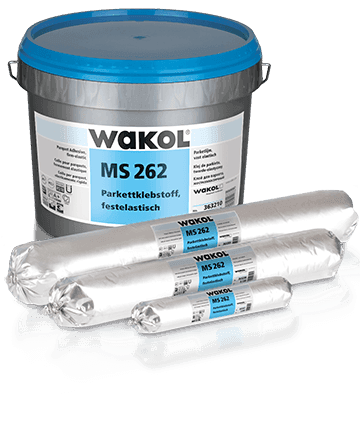
WAKOL MS 262 is a one-component, firm-elastic adhesive with no mixing and no venting time. A compatible foil-bag gun and the special WAKOL triangular nozzle are the simplest permitted route — but only for the permitted formats.
| Tool | Indicative consumption | Typical permitted use |
|---|---|---|
| Triangular nozzle, beads | 600–800 ml/m² | strip parquet, multi-layer from 90 cm, permitted solid boards |
| Triangular nozzle + TS 160/170 | 450–500 ml/m² | only for application into the grooves of the TS 160/170 system, per its instructions |
| Nozzle 200-11-3.5 | 600–850 ml/m² | larger multi-layer, strip and solid parquet |
| Nozzle 200-18-3.5 | 425–650 ml/m² | smaller multi-layer and edge-grain lamellas |
| TKB B3 | 500–600 ml/m² | mosaic and smaller multi-layer parquet |
| TKB B5 | 425–550 ml/m² | larger engineered parquet and cork on a carrier |
| TKB B11 | 600–725 ml/m² | edge-grain lamellas, 10 mm and strip parquet |
| TKB B13 | 700–800 ml/m² | larger strip, multi-layer and solid elements |
| TKB B15 | 850–950 ml/m² | large multi-layer and solid elements |
| WAKOL Specialty Trowel 5 | 1,700–1,800 g/m² | tongue-and-groove only; unheated cement ≤4 CM % / 90 % KRL or concrete ≤6 % by mass / 90 % KRL |
Specialty Trowel 5 is a special route with its own substrate limits and is not a general substitute for a normal trowel.
The result is a range based on the declared consumption. Check the actual job for reserve, waste, unevenness and exact packaging.
Record the construction, the dimensions, tongue-and-groove or click, and the manufacturer's approval for full-surface bonding.
Check the type, the moisture, the flatness, the strength and any cracks. Prepare a calcium sulphate screed mechanically and vacuum it thoroughly.
Always separate mastic asphalt with PU 280 or MS 330. Seal residual moisture only within the permitted TDS limits and on a permanently moisture-resistant substrate.
Balance the cuts, mark the reference axis and prepare the spacers before you open the bag.
Use a compatible foil-bag gun and the chosen WAKOL nozzle or the correct TKB trowel.
Run the triangular beads across the boards every 8–10 cm; with the multi-nozzle head, run them parallel. Do not wait for venting.
Lift the first elements, check that the underside is wetted and keep checking the geometry as you go.
After testing, remove fresh marks immediately with RT 5960; cured material only mechanically. Surface treatment normally after 12 h on an absorbent and 24 h on a non-absorbent substrate; setting takes about 24 h.
PU 280 and MS 330 do not replace structural waterproofing.
Adhesive does not strengthen a substrate that cannot carry the load, and it does not close an active crack.
Smaller elements need the approved multi-nozzle head or full-surface application.
Large formats demand flatness; adhesive is not a levelling compound.
Last updated: